


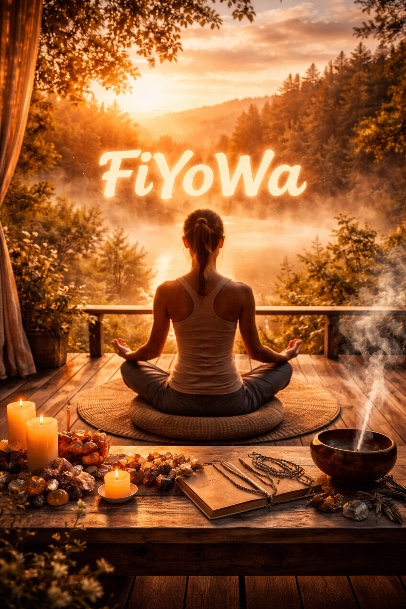
Of course, just as with the other posts, the ‘FiYoWa reminds you …’-conclusion right at the very end. I would also connect it a little more closely here to the essence of meditation, breathing and rituals:
2.9 – Spiritual Tools
Meditation, breath, rituals
People carry within them much of what they need for clarity, direction, and inner stability.
Yet this knowledge is often lost in everyday life.
Thoughts become loud.
Feelings become unsettled.
Decisions become uncertain.
The connection to yourself grows quieter.
This is exactly where spiritual tools can come into play.
Not as magic.
Not as an escape from life.
But as Tools.
Tools that lead you back to yourself.
Why tools matter
A tool does not change your life on its own.
But it gives you the opportunity to act consciously instead of simply reacting to life.
Meditation creates space in the mind.
Breath brings you back to the moment.
Rituals give meaning to particular moments.
These are simple methods that people have used for thousands of years, across cultures, eras, and belief systems.
Not because they are complicated.
But because they touch something very fundamental:
the human being themselves.
You do not need a special title for this.
No special clothing.
No particular belief system.
All you need is the willingness to reconnect with yourself consciously.
Meditation: The Space Between Thoughts
Meditation does not mean no longer having thoughts.
That is a widespread misunderstanding.
Meditation is more about noticing your thoughts without having to follow every single one.
A thought arises.
You notice it.
And lets it move on.
A feeling arises.
You notice it.
And you do not have to react to it immediately.
Over time, something precious emerges:
Distance.
And in that distance, freedom of choice emerges.
You may realise:
What really matters?
What is merely habit?
Which thoughts really belong to me?
Which ones have I taken on?
What strengthens me?
What drains my energy?
Meditation does not necessarily bring new answers.
Sometimes it simply removes the noise that keeps you from hearing the answers that have long been within you.
Meditation is not a retreat from life
Spiritual practice is sometimes seen as an escape.
But the exact opposite can happen.
Pausing regularly does not automatically make you less active.
You become more conscious in your actions.
You react less out of habit.
You recognise your emotions sooner.
You notice your thoughts more quickly.
You can make decisions with greater clarity.
Meditation therefore does not mean:
"I am leaving the world."
But:
"I am learning to be consciously present in the world."
Breath: the quickest connection to yourself
Something accompanies you from the first to the last moment of your life:
your breath.
You can go days without food.
Some time without water.
But without breathing, only a few minutes.
And yet we often pay hardly any attention to this constant companion.
Our breathing constantly changes along with our inner state.
Under stress, it often becomes faster and shallower.
At rest, it usually becomes slower and deeper.
Its quality changes when you are afraid.
It also changes when you relax.
Breath connects body and consciousness.
And that is precisely why it can become a tool you can use immediately.
One conscious breath can bring you out of a spiral of thoughts and back into your body.
Another one.
And another one.
Suddenly, you're here again.
The Breath as an Anchor
You don't always have to meditate for hours.
Sometimes a few conscious breaths are enough.
Pause briefly.
Breathe in slowly.
Notice how your body moves.
Slowly breathe out again.
And observe.
Do not judge.
Do not force it.
Just notice.
In doing so, you give your system a simple signal:
I am here.
The breath becomes an anchor.
An anchor you can take with you anywhere.
Into a difficult conversation.
Into a stressful working day.
Into a moment of uncertainty.
Or simply into the middle of an ordinary day.
Rituals: conscious transitions in life
A ritual is more than an action.
It is a conscious decision to give meaning to a moment.
You can light a candle in the morning.
Spend a few minutes in silence.
Observe your breath.
Feeling gratitude.
Writing.
Praying.
Going out into nature.
Or consciously bring the day to a close.
What matters is not the outward form.
The awareness behind it is what makes the ritual.
A morning ritual can help you find direction.
An evening ritual can help you let go.
A shared ritual can connect people with one another.
Rituals create islands of awareness in a world that keeps moving.
Rituals remind you that your life has meaning
Modern daily life often consists of transitions that we barely experience consciously anymore.
Getting up.
Working.
Shopping.
News.
Appointments.
Screen.
Sleeping.
And back to the beginning again.
Rituals interrupt this automatic pattern.
They say:
This moment matters.
Not because something spectacular happens.
But because you are present.
Perhaps that is precisely where its original power lies.
They turn an ordinary moment into a conscious one.
Simplicity instead of perfection
You do not need a perfect meditation room.
No special music.
No complicated breathing technique.
No sunrise on a mountain.
You can start right where you are.
Five minutes of silence.
Three conscious breaths.
A walk without your phone.
A moment of gratitude.
A candle in the evening.
A few lines in a book.
A conscious question to yourself.
What do I really need right now?
That's enough.
Spiritual practice does not have to be grand.
It has to be authentic.
Consistency changes more than intensity
Many people seek a major experience.
That one meditation.
That one ritual.
That one breakthrough.
But awareness often grows in unremarkable ways.
Through repetition.
Through small moments.
By returning every day.
One breath.
A conscious thought.
A moment of silence.
An honest decision.
Again and again.
And at some point you notice:
You respond differently.
You feel things sooner.
You recognize things more quickly.
You become calmer.
Not because life has suddenly become easier.
But because you have learned to stand within it differently.
The true purpose of spiritual tools
Spiritual tools are not meant to make you dependent.
Not from a teacher.
Not on a method.
Not on a ritual.
Not on a particular person.
Nor on a particular state.
Their purpose is exactly the opposite:
They are meant to make you more independent.
More independent of your automatic patterns.
Less dependent on your impulsive reactions.
Less dependent on inner chaos.
And ever more connected to your own perception.
That is why the best tool is not the one you need forever.
But the one through which you learn to guide yourself better and better.
Spiritual tools need to become part of everyday life
Meditation is valuable.
But what happens afterward?
How do you speak to another person?
How do you handle conflict?
How do you make decisions?
How do you treat yourself?
How do you deal with fear?
How do you handle power, money, relationships, and responsibility?
That is exactly where you find out whether a tool has truly become part of your life.
Because awareness is not only what you experience during meditation.
Awareness shows in how you live afterward.
No path bypasses yourself
You can read a hundred books.
You can do a thousand meditations.
You can know the most beautiful rituals.
You can learn the best techniques.
But sooner or later, every path leads back to the same question:
How consciously am I willing to meet myself?
Because no tool can take responsibility for your life away from you.
No ritual can decide for you.
No meditation can feel for you.
No breath can make the decision about what to do with your life for you.
The tools can support you.
But you have to walk the path yourself.
The human being as their own tool
Perhaps this is the deepest insight:
You are not dependent on an external tool.
You can learn to observe your consciousness yourself.
To guide your breath.
Noticing your emotions.
To question your thoughts.
To shape your rituals consciously.
And the more you develop these abilities, the less you need from the outside world to reconnect with yourself within.
Then meditation, breath and rituals do not become escape routes.
They become bridges.
Bridges back to yourself.
The path into the new world
The new world does not arise from new ideas alone.
It comes into being through people who relate differently to themselves and to one another.
People who act more consciously.
People who take responsibility.
People who reclaim their attention.
People learning to regulate themselves instead of constantly projecting their inner restlessness onto the outside world.
Perhaps that is why this change begins on a much smaller scale than we think.
With one conscious breath.
With five minutes of silence.
With a ritual.
With a moment in which you perceive instead of reacting.
And perhaps that is exactly where something new begins.
Not somewhere outside yourself.
But within you.
Core
🜂 Tools change nothing if you do not use them.
🜂 Small, conscious actions can bring about big changes.
🜂 Spiritual tools are meant to lead you back to yourself, rather than make you dependent on yourself.
FiYoWa reminds you …
that you do not need to keep finding more outside yourself to come back to who you are: sometimes a conscious breath, a moment of silence and the decision to truly listen to yourself again are enough.